
Shitshow Macro Issue 5: The Eagle and the Bear
From Tsars to Bolsheviks to Boogeymen: a history of the Western & Russian evolution from allies to frenemies to enemies

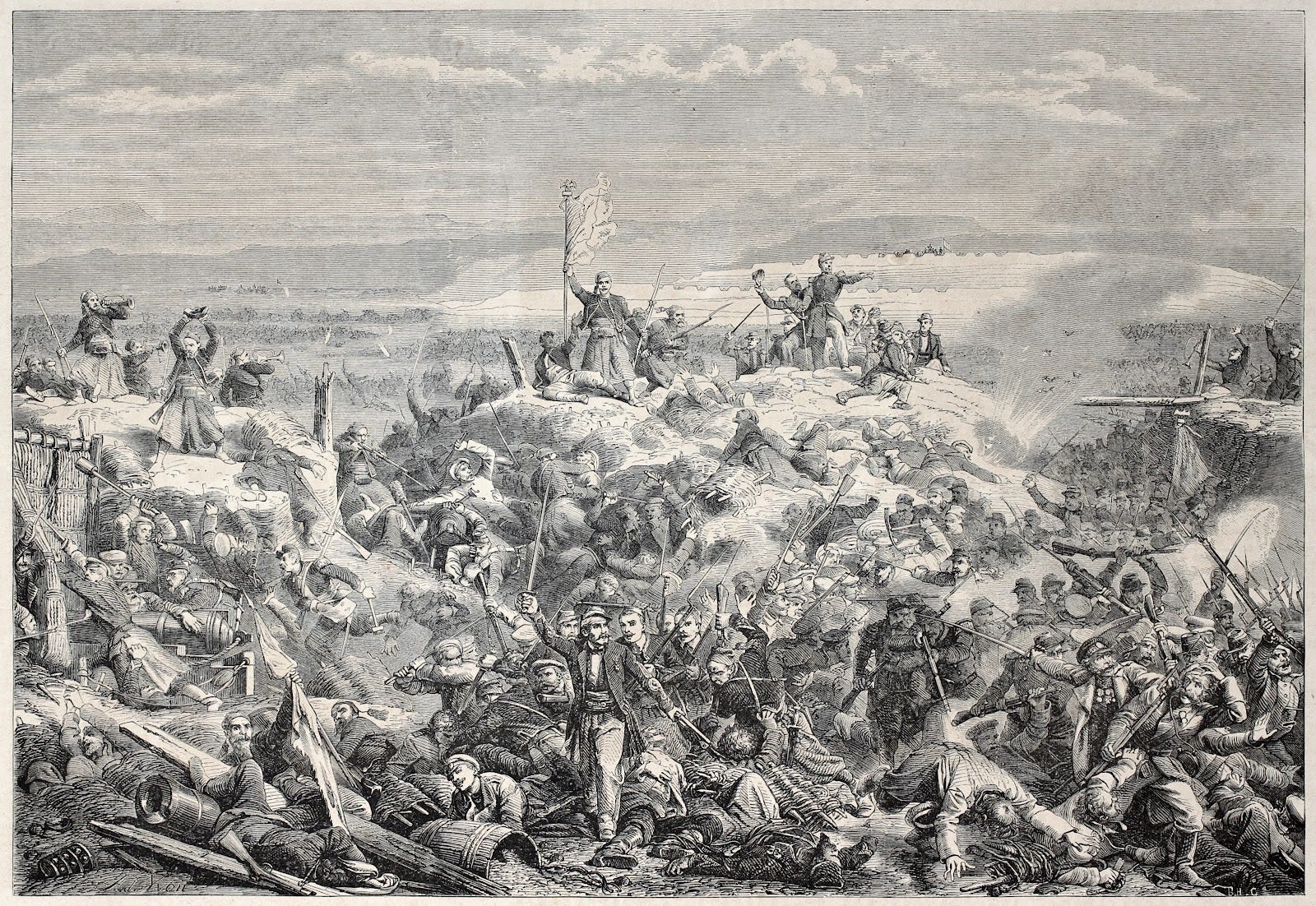
Old illustration of the taking of Malakoff by French army during Crimean war. Created by Yvon, published on L'Illustration Journal Universel, Paris, 1857
Money, war, religion, markets, geopolitics, social dynamics, the human condition, and societal implications. As everyone with a platform spends their time hyperfocused on single issues that draw you in, this is my attempt to step back to show the larger picture (and potential implications or concerns).
The ever-changing media cycle seems built to give us the attention spans of fruit flies - but there are issues that we should take the time to focus on and understand.
These are those issues.
Topics covered in this edition
Why the “know your enemy” mantra is so important - and dangerous that so many “leaders” in DC and the Pentagon seem to ignore it these days.
A brief history of Russia, how it went from being ruled by a Tsar who was blood-related to the rest of the world’s rulers to Bolsheviks and now a former KGB agent + oligarchs.
Russia’s history as a staunch ally of the USA and the West, including its actions that prevented outside nations from taking advantage of the chaos during our Revolutionary and Civil Wars, and absorbing the brunt of casualties fighting the Central Powers in WWI and Axis Powers in WWII (both enemies included Germany, who had a hand in the Bolshevik Revolution).
Why did Russia remain a boogeyman for the West even after the Berlin Wall fell?
Economics: Is it really necessary for NATO to exist to keep a single nation in check whose GDP is a fraction of each of the leaders of NATO?
What happened to the one Western leader who knew how to effectively manage a relationship with Russia?
Why were Western sanctions against Russia implemented by the Biden Regime so counterproductive?
How have all of these things morphed into the current geopolitical Shitshow that we’re facing?
Introduction
It’s a sad state of affairs when someone trying to sum up geopolitics and history has to begin their lesson with a qualifier like this, but as I’ve found myself repeating far too often these days, “It is what it is.”
As I outlined in my previous post, a major US media outlet spun a group of bald-faced lies in telling its readers that I was working with Erik Prince and the Russian GRU to plan an overthrow of the USGOV on January 6th, which should be laughable to any rational human being.
I’ve never met or spoken with Erik Prince for one, and the slightest bit of due diligence on me and the books that I’ve written shows that I’m certainly no fan, ally, or friend of Russia. They are one of the main antagonists in my book trilogy The Pact, and despite 3 enemy nations being the face of the fighting, the main antagonist in Book II is a Russian operator nicknamed The Bear.
If you’ve read my books, you have a pretty good understanding through the graphic nature in which I described his demise and general (brutal) demeanor of how I feel about Russia as an enemy state. But “journalists” in the US media have decided to make themselves ridiculous laughing stocks by ignoring reality to push political narratives, so again, “It is what it is.”
Despite how I personally feel about Russia, my knowledge of their hacks of our TS infrastructure while I was in Iraq, or their GRU agents (and Chechen fighters) being all over Afghanistan while I was there, I feel it’s necessary for Americans and people of the Western nations to know more about that nation, and more importantly, our history with that nation than they currently do - especially in our present moment.
For one, the very survival of a Republic depends on it having an enlightened populace. As I look around today, I see the vast amount of time, money, and effort that has been/is being spent to ensure that Americans are anything but enlightened or aware of the reality of the world, and that terrifies me.
“Know thy enemy,” is sage advice, but the West has allowed itself to be propagandized and misled for so long about so many things that we are woefully uninformed.
That being said, let’s set some “table stakes” about Russia before we dive into why they’re such a force on the geopolitical stage right now (and are being used as a boogeyman, in my opinion, to cover for other, more dangerous threats):
Vladimir Putin is not a good guy. He’s a former KGB agent who “cut his teeth” operating in East Germany while the USSR was still full-blown Bolshevik. He’s probably murdered people in cold blood during that time, and it’s not a stretch to imagine he’s ordered far more killings once he entered politics.
Putin does not have our best interests at heart, nor should he. He’s the leader of his country, not ours, and his actions are aligned to those ends. We can’t know precisely why he granted Tucker Carlson an interview, but we can rest assured that there were ulterior motives behind his decision.
The Soviet Union under Lenin, Stalin, and Trotsky was an absolutely brutal regime that led to far more deaths than Nazi Germany under Hitler. The only communist dictator with more murders under his belt was Mao in China. Modern-day Russia is not the Bolshevik Soviet Union anymore, but it certainly isn’t a free and open society.
To the above point: one thing that many multi-deployment GWOT veterans came home with after “dancing in the desert” was a keen understanding that some cultures simply require a brutal, iron-fisted leader at the helm. You can complain about that all that you want, but we saw it in all of its brutal honesty as we spent the best years of our lives trying to “bring democracy to the Middle East.” There’s a deeply engrained reason that it didn’t take.
For those keeping score, it seems that Putin is several steps ahead of the Biden Regime and NATO in terms of Ukraine. Even without considering the actual war, the US sanctions only strengthened Russia’s economy and gave a substantial amount of push to the BRICS coalition for rapid growth.
Despite what the Western media tells you and tries to portray every conflict or political scandal as, there typically is no “black and white, good guy vs bad guy” in statecraft and geopolitics. If you believe that US foreign policy has been run by saints for all of our history - you don’t know anything about history. We do, however, seem to have more diplomats “representing” our interests abroad in ways that actually damage our nation and her interests than any other nation. This is not a good thing to be leading the world in.
Those of us who have been wary or critical of supporting Ukraine in this current war are not Putin apologists or Russian sympathizers or whatever the idiot and propaganda-fueled Western media want you to believe, nor were we “rooting” for Russia to win. We are simply realists who understand the situation, and that honest brokers know it was of our own making. We will get into that more below.
Over the last year and again in the time since his interview with Putin aired, Tucker Carlson has come out publicly with the fact that the US Intelligence Community (IC) hacked his Signal messages trying to arrange the interview and then leaked them to reporters (I believe it was with the New York Times, but I could be wrong).
Take a moment to really consider that.
Beyond the obvious fact that in a rational, logical, and normal society that was functioning with a truly free & fair media, other journalists would stand up and cry foul that the IC and surveillance state apparatus was spying on a journalist who simply wanted to interview a world leader whose nation was engaged in a major, society-changing war.
Rather than cry foul that Tucker was being spied on by the US government, the Western corporate media locked arms to attack and hurl insults at him, telegraphing the message that anyone who watched the interview was a traitor or some sort of Russian asset.
Let’s be honest: none of the Western corporate media stood up when Julian Assange was persecuted for revealing government lies, nor did they for Edward Snowden or even just this week when Catherine Herridge was fired by CBS and had her notes from confidential sources taken by her former employer.
Those sources had been revealing damaging information about The Biden Regime, so of course the media refused to defend their colleague.
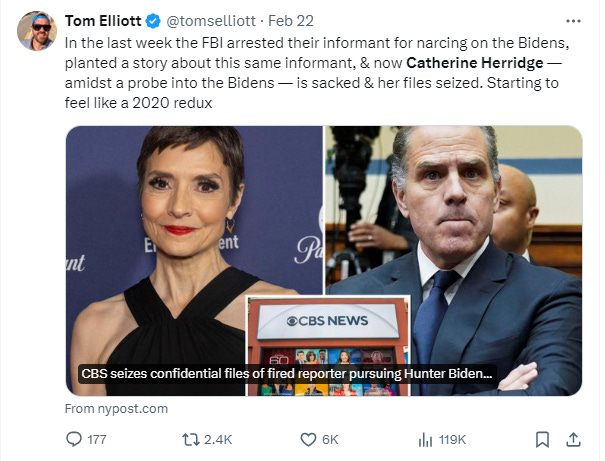
To put the US media’s propaganda efforts into the full light with respect to Tucker interviewing Putin, here’s a brief (and not even complete) list of some of the other corporate media journos who have sat down and interviewed Putin and other despots, dictators, or outright terrorists - many of them quite recently.
CNBC’s Hadley Gamble interviewed Putin in October 2021
NBC News senior international correspondent Kier Simmons interviewed Putin in June 2021
The Associated Press interviewed Putin in September 2013
The New York Times published an op-ed by Putin in September 2013
The New York Times also published an op-ed by Taliban deputy leader Sirajuddin Haqqani in February 2020
CNN interviewed Al Qaeda terrorist Osama bin Laden in a cave in Afghanistan 4 years before 9/11
Western corporate journalists have interviewed a wide range of world leaders, terrorists, despots, dictators, and generalissimos in the past - and yet many of them locked arms to call Tucker Carlson a “Putin sycophant,” “traitor,” “Russian apologist” and numerous other slanderous names when he decided to do what many of them have done over the past decades.
Why? What changed?
We’ll get into that, but first, we must understand the history of Russia, and that it has far more years under its belt as an ally of the USA than it does as an enemy. That may make some of you uncomfortable to even read, but it’s necessary to understand.
If you’re going to battle an enemy in the great global power competition, you have to understand how they are likely to respond to every one of your moves.
To understand how they will respond, you have to understand how they think.
To understand how they think, you have to understand their history and be willing to be brutally honest about whether they have any legitimate grievances toward you - if potential diplomatic solutions are to be considered.
Remember the von Clauswitz motto that I’ve tried to etch into each of your memories with previous posts:
“War is politics through other means.”
If you’re having a hard time understanding why former US allies like India and Saudi Arabia are currently aligning with Russia by joining BRICS rather than staying by our side…hopefully we can clear that up for you below.
But first, we have to go through a history lesson. It won’t be nearly as long as Putin’s diatribe with Tucker, but there are some things that most Americans don’t know that are crucial to truly understanding why US/Russia relations are currently where they are.
From Tsars to Bolsheviks to Former KGB Agents
As we covered in the previous Iran post, US leaders and talking heads seem to have a hard time understanding that centuries-old civilizations like China, Russia, and Iran see the world in very different terms than we do. They have deeper histories, blood feuds, and more experience with unlikely alliances that have been formed over epochs while the breadth of our history books only spans a couple of centuries.
It is darkly funny (but not in a ha-ha kind of way) that most of our statecraft and foreign policy since the 1950s has been focused on keeping Russia and China from becoming too close and keeping Germany and Russia from becoming too close.
From an extremely high-level perspective, this was to prevent the German manufacturing base from gaining the plentiful natural resources (mainly energy) of Russia that could “cut us out of the loop,” or give China’s massive population (and now American-funded manufacturing base) access to that same energy export capacity.
We had a lot of things going for us in those respects, and we’ll get into NATO and its efforts on those fronts below.
And while we’ll get into China specifically in a future (hopefully the next) post, we can’t really get into Russia’s history without mentioning the Panda at least briefly in this post.
Centuries of strained Russo-Sino relations
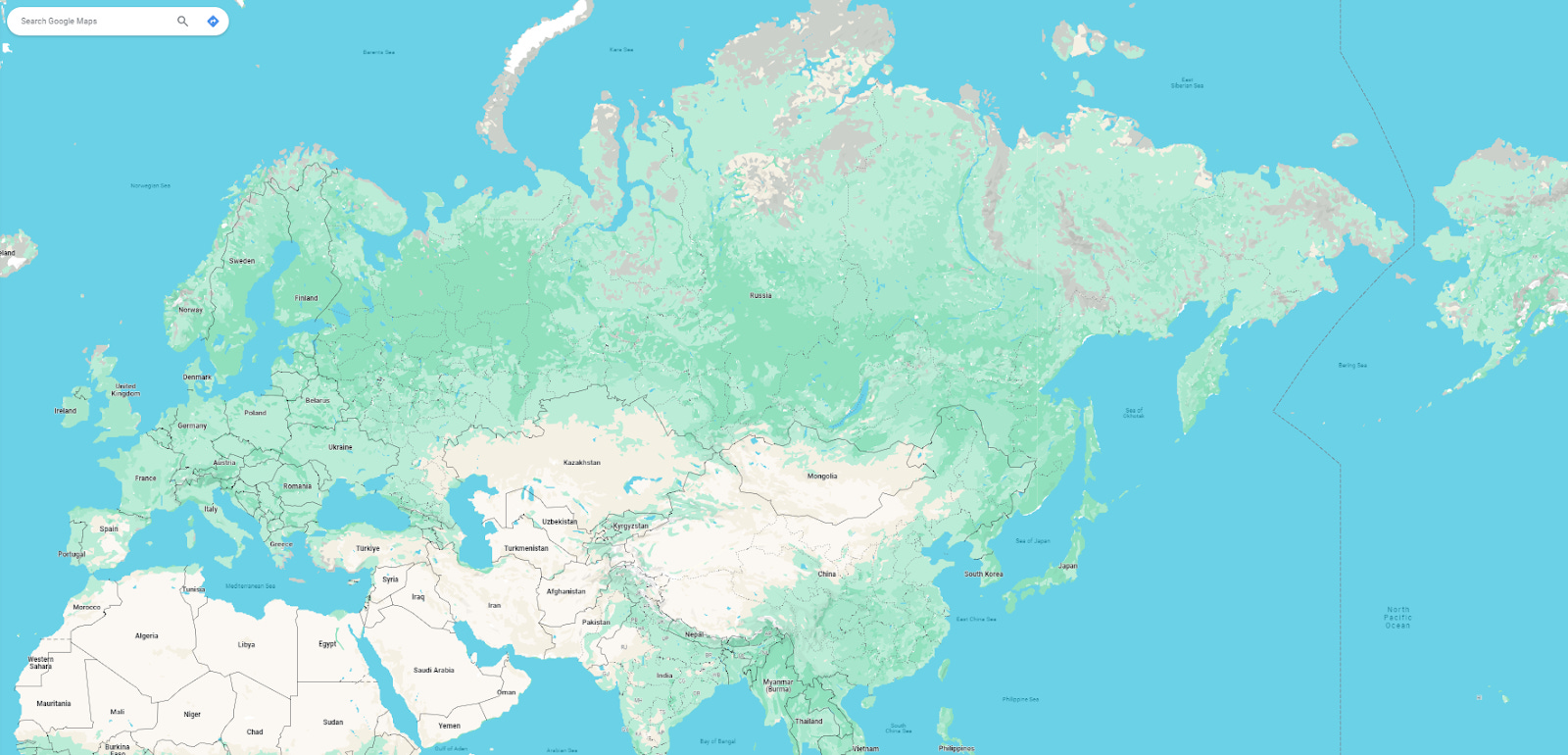
Americans often have a hard time conceptualizing the sheer size of Russia, so it may be worthwhile to take a moment to look at the map above to realize a few things. Firstly, their landmass is insanely large and very resource-abundant.
Also important to note is the relative proximity between Russia and Alaska. Do you remember when Sarah Palin was roundly mocked and derided by the US corporate media for claiming that she could, “see Russia from her home in Alaska?” Take a look at the map and realize what disingenuous garbage the Western corporate press is.
For the purposes of this section, I included the map to outline another point: look at the proximity of China to Russia and understand the well-known fact that China has over a billion people - despite being only a fraction of the size of Russia.
If you’ve ever read the book Guns, Germs, and Steel: The Fates of Human Societies by Jared Diamond you probably have an inkling of why this is important for more than just the sheer size differential.
Sure, the border between China and Russia is the largest international border in the world, spanning 4,209 kilometers (or roughly 2,615 miles). Mongolia, Kazakhstan, and Kyrgyzstan are merely satellites of each nation, so while they may not be “officially” borders, in practice and reality they are - and they were officially borders not all that long ago.
Most notably, in addition to China being far smaller, much of the northwest region of the country is not very productive in terms of resource-producing capacity. This region is where the CCP keeps the largest number of concentration and reeducation camps for the Uighur Muslim population, who had their own lands until they were taken over by China. This plays a significant role in my upcoming The Pact Book III, and those who understand the modus operandi of Green Berets can probably make an educated guess as to why it does.
Both the official and unofficial borders have changed significantly between the two nations a lot since they coalesced from warring tribes to cohesive states, and there is a deep history between the two as friends, frenemies, and outright enemies. Here’s a very brief & summarized timeline of the history of Russo-Sino relations:
Early Interactions:
Historically, China and Russia shared borders in the Far East, leading to interactions between the two civilizations. These interactions were often characterized by trade, cultural exchange, and occasional conflicts.
Treaty of Nerchinsk (1689):
The Treaty of Nerchinsk, signed between the Tsardom of Russia and the Qing Dynasty of China, marked the first formal treaty between the two powers. It established the Russia-China border along the Amur River, delineating spheres of influence in the region.
Expansion of Russian Empire:
During the 19th century, the Russian Empire expanded eastward into territories traditionally claimed by China, including Siberia and the Russian Far East. This expansion brought Russia into closer proximity to China and sometimes led to tensions over border disputes.
Russo-Chinese Wars:
The 19th century saw several Russo-Chinese conflicts, including the Russo-Chinese War of 1686-1689 and the more significant Opium Wars involving British and French forces in the mid-19th century. These conflicts weakened China and contributed to the expansion of Russian influence in the region.
Sino-Soviet Relations:
In the 20th century, relations between the Soviet Union (of which Russia was a part) and China went through various phases. Initially, the Soviet Union supported the Chinese Communist Party (CCP) under Mao Zedong, providing military and ideological assistance.
However, tensions emerged between the two communist powers during the 1950s and 1960s, leading to the Sino-Soviet split. The split was driven by ideological differences, national interests, and competition for leadership within the communist world.
The border dispute between China and the Soviet Union also led to armed clashes in 1969 along the Sino-Soviet border in the disputed region of Zhenbao Island (known as Damansky Island in Russia). This conflict further strained relations between the two countries.
*note: there are indications that China is now claiming Zhenbao Island as its own again on maps, which could very well either lead to future tensions or be an indicator of non-public and recent agreements between the two nations
Post-Soviet Era:
Following the dissolution of the Soviet Union in 1991, Russia inherited the relationship with China. In the post-Soviet era, Sino-Russian relations have improved significantly, marked by increased economic cooperation, trade, and strategic partnership.
Both countries have cooperated on various international issues, including opposition to Western hegemony, support for multipolarity, and joint military exercises.
21st Century Partnership:
In recent years, Sino-Russian relations have deepened, particularly under the leadership of Russian President Vladimir Putin and Chinese President Xi Jinping. Both countries have strengthened economic ties, with China becoming Russia's largest trading partner.
Additionally, Russia and China have enhanced military cooperation, conducted joint military exercises, and collaborated on energy projects, including the construction of pipelines.
There is quite a lot left out of the timeline above for the interest of time, but it’s a good high-level understanding of how far back relations between the two nations go. Their first treaty was nearly a century before the USA even existed as its own nation, and the centuries before that were filled with trade, killing each others’ emissaries, border skirmishes, and outright plundering of each others’ villages.
The Bolsheviks and Mao
We’ll get into the Western interests’ responsibility for foisting Lenin, Trotsky, and Bolshevism on Russia further below, and I don’t want to mess up the timeline too much. In terms of Russo-Sino relations, however, it is important that we note how the Bolsheviks/Soviets helped Mao and his communist revolution in China which eventually became the CCP.
We will go into far greater detail in the future China post, but the Soviet Union (after the Bolshevik Revolution there) was the main base of financial support for Mao as he was building his communist state. This is important to note here because Mao’s Great Leap Forward led to tens of millions of deaths by starvation because he insisted on exporting what little grain they had to “keep up appearances” that communism was going well as his people starved to death.
The failures of communism under Mao required his nation to be propped up by his Soviet benefactors, who were sending Mao money even as their own Russian people starved to death (and were murdered in large numbers by the Chekka death squads). This lasted for decades and eventually led to a warning to the US that China was going to switch its financial parasitism from Russia to the US when its neighbors grew sick of playing sugar daddy.
If you’ve not read The Hundred Year Marathon: China’s Secret Strategy to Replace America as the Global Superpower by Michael Pillsbury, you should. I will mention it again in the China post, but it spells out quite a few ways in which the US foreign policy establishment has screwed us over royally.
In a small section at the beginning of the book, Pillsbury outlines his time working at the UN building in NY, and receiving a warning from a Soviet military officer who had a few too many vodkas at lunch of how they were cutting China off from foreign aid and China’s plan was to suckle at the teet of the American taxpayer largesse.
That warning came painfully true, and the US foreign policy establishment was either stupid or crooked enough to essentially build up the nation that has been aiming to replace us. The timeline above helps to explain why this is one of China’s top priorities (Opium Wars), but we’ll save the deeper explanation into that for the China post.
Or you could get the book or audiobook now and be ahead of the game.
I highly implore you to do so.
How wars led to the usurpation of the Tsar and Bolshevik Revolution
For over 300 years from the 1600s until July 17, 1918, Russia was ruled by the Romanov family. This bloodline-based rule started when 16-year-old Mikhail Romanov, the son of Russia’s religious patriarch was chosen to take the throne in 1613.
So how did Russia go from being led by the dynasty of a religious leader to devolving into a Godless, atheistic Communist hellhole run by Bolsheviks?
Let’s briefly explain this. Before we do, it’s important to remember Putin’s appeals to his and his nation’s religious history and background, as he’s routinely stated publicly that his main goal is to bring Russia back to its “glory days” of pre-Bolsheviks.
It’s also important to remember because it sets a clear distinction between the Soviet Union/USSR and modern-day Russia. Again, Putin is a shithead, that’s a given. But a wise person can be wary of his enemies and still allow himself to be informed about their thinking/aims/stratagems.
The Romanov dynasty led to some names that most of you have likely heard of: Alexander I, Peter the Great, Catherine the Great (who prevented outside nations from stepping during our Revolutionary and Civil Wars, which we’ll cover below), and finally Nicholas II.
During the Romanov reign, Russia was largely considered a European nation. Not only had the country sided as an ally with the West in many (not all wars, but most of the big ones), but as with the practice of the time, the Romanov family was largely interbred with the rest of Europe’s ruling families.
In fact, here’s a list of the European rulers whom Tsar Nicholas was related to by blood at the time of his death:
King George V of the United Kingdom: Tsar Nicholas II and King George V were first cousins through their shared grandmother, Queen Victoria of the United Kingdom. Both were grandsons of Queen Victoria, Nicholas being the grandson of her daughter, Alexandra, and George being the grandson of her son, Albert Edward (later King Edward VII).
Kaiser Wilhelm II of Germany: Tsar Nicholas II and Kaiser Wilhelm II were first cousins through their shared grandmother, Queen Victoria. Both were grandsons of Queen Victoria, Nicholas being the grandson of her daughter, Alexandra, and Wilhelm being the grandson of her daughter, Victoria, Princess Royal.
King Christian X of Denmark: Tsar Nicholas II was related to King Christian X of Denmark through various intermarriages among European royal families, although the exact familial connection may be more distant.
King Haakon VII of Norway: Tsar Nicholas II was related to King Haakon VII of Norway through various intermarriages among European royal families, although the exact familial connection may be more distant.
If you’ve not read The Guns of August, this Pulitzer Prize-winning book goes into great detail about the lead-up to WWI and how friends, cousins, and brothers at the helm of nations were suddenly pulled into World War against each other due to an overzealous German general, poorly-designed treaties, and military & academic “experts” who thought that humanity would never see another war.
Seriously. Just 10 years before the outbreak of WWI a book was published by an academic “proving” that the economic interconnectedness of the world would prevent any future wars. It was so popular and well-received that it was translated into dozens of languages and became the Gospel truth of the day.
And then WWI broke out just a decade later.
Keep that in the back of your mind whenever someone says the US and China will never go to war because of commerce.
So what happened on July 17, 1918, that ended a 3-century rule by the bloodline of the religious patriarch of Russia? How did a world leader who was blood-related to all of the other major world leaders have this happen to him and his family?
The Bolsheviks happened. But where did the Bolsheviks come from?
That’s the trillion-dollar question that there are answers to, but most in the West are unaware of those answers.
Nations need to focus on their own people more than wars abroad
The Founding Fathers of our nation did a lot of deep historical research to determine what system of government would work the best and provide the most economic and personal freedoms for the people of our new country.
There’s a quite infamous quote from Ben Franklin, that is attributed to his response to a woman who asked what type of government the US would have when he walked out of the Continental Congress.
While the situational accuracy may not be 100%, the quote is entirely prescient given our current situation:
“A Republic, if you can keep it.”
Most of the Founding Fathers’ greatest fears were a standing army and a central bank because they understood a few basic elements from historical analogs of other Republics:
Central banks and warfaring nations become inseparable and inevitable
Any nation that focuses more on outward expansion by conquest than its own people is destined for self-destruction
Tsarist Russia was not a Repulic by any stretch of the means, and despite it being in the name, neither was the Bolshevik-led USSR (commies always bastardize the term “Republic” to give themselves a false air of legitimacy).
The history of the world is filled with nation-states funding, equipping, and fomenting revolutions to weaken or destroy their enemies. Pakistan created The Taliban as a destabilizing force for India, and the West (US bankers in New York) and Germany colluded to send Lenin, Trotsky, and the Bolshevik revolution into Russia to weaken that nation.
That may sound like a conspiracy theory to you, but it's been documented via long declassified spy cables and communiques from that period.
However, no matter how much money or funding revolutionaries have, they still need a crack in the armor, some onus, or a push that they can use to drive a wedge between enough of the populace and its leadership to overthrow a sitting government.
Germany’s goal in destabilizing Russia was to take its massive armies out of WWI (remember, Russia fought against Germany in both WWI and WWII). The Western bankers in NY and London simply wanted cheap labor & access to cheap natural resources and knew that communism would bring it for them in massive numbers.
The wedge for the populace, however, was different. The Bolsheviks used many tactics and lies to whip the people of Russia into a revolutionary frenzy, and much of it centered on the same reasoning why Ben Franklin feared we may not be able to hold onto a Republic for very long.
Here’s a list of the wars that Russia participated in before the Bolsheviks took over:
Livonian War (1558–1583): Fought primarily between the Tsardom of Russia and the Livonian Confederation, which was supported by the Polish-Lithuanian Commonwealth and the Kingdom of Sweden.
Russo-Polish War (1654–1667): Also known as the Thirteen Years' War, it was fought between the Tsardom of Russia and the Polish-Lithuanian Commonwealth over territories in modern-day Ukraine and Belarus.
Great Northern War (1700–1721): Fought between the Russian Empire, led by Peter the Great, and a coalition of northern European powers, including Sweden, Denmark-Norway, and Saxony-Poland.
Russo-Turkish Wars: There were multiple Russo-Turkish wars throughout history, including the:
Russo-Turkish War of 1768–1774
Russo-Turkish War of 1787–1792
Russo-Turkish War of 1806–1812
Russo-Turkish War of 1828–1829
Russo-Turkish War of 1877–1878
Napoleonic Wars (1803–1815): Russia, under Tsar Alexander I, participated in the Napoleonic Wars against France and its allies. The French invasion of Russia in 1812 is particularly notable.
Crimean War (1853–1856): Fought primarily between Russia and an alliance of France, the United Kingdom, the Ottoman Empire, and Sardinia. The conflict centered on competing interests in the Balkans and the Middle East.
Russo-Japanese War (1904-1905): A war fought over competing interests of Japan and Russia in Manchuria and Korea, particularly over warm water ports and the Trans-Siberian railway. Japan’s navy soundly defeated Russia’s in the first time an Asian military bested a European one. The conflict’s end was mediated by US President Teddy Roosevelt with the Treaty of Portsmouth.
World War I (1914–1918): Russia was a major participant in World War I, initially fighting against the Central Powers (Germany, Austria-Hungary, and the Ottoman Empire).
Russian Civil War (1917–1922): Fought between the Bolshevik (Red) forces, led by Vladimir Lenin and later Joseph Stalin, and various anti-Bolshevik (White) factions, including monarchists, liberals, and socialists.
Russia had strayed far behind the rest of Europe in terms of technological advancements, and despite the bountiful natural resources the nation had, its population had remained largely agrarian and poor. Catherine the Great had tried to make some society-wide changes to bring them “up to the times” during her rule, but they were still far behind by the time the Germans and New York bankers started eyeing Lenin’s potential to destabilize Russia.
The sounding defeat of the Russian Navy by the Japanese Navy in 1905 was a massive black eye to the country that cannot be understated, and jumping into WWI less than a decade later created the wedge that the Bolsheviks used to lull the population into accepting the lies of Marxism/Leninism/Bolshevism.
From the West, with love: Bolshevik destabilization operations to weaken the Tsar
Why Lenin and Trotsky were specifically chosen by Germany and New York to destabilize Russia is a story in and of itself that will add far too much to this post.
If you’ve never read it, I wrote a series of articles for UncoverDC called History Doesn’t Always Repeat, Itself, but the Darkest Parts Always Do.
This 5-part series was a deep dive into all of the murderous Marxist dictators of the past, and how they all came from alarmingly similar backgrounds, used nearly identical blueprints to rise to power, and did nearly the same things once they were able to seize power (that always led to millions, tens of millions, or hundreds of millions of deaths).
The series focuses on the “worst of the worst,” including Mao, Lenin, Stalin, Hitler, Mussolini, Pol Pot, and Castro. You may have been led to believe that Hitler and Mussolini were in opposition to each other, but if you look at their history they mirrored each other in nearly every detail of what they did.
Nobody talks about how Mussolini’s genocides in N. Africa in his quest for “spazio vitale” (living space) was the same as Hitler’s “lebensraum” (living space), nor how Hitler’s brownshirts were set up in a direct mirror to Mussolini’s blackshirts - both of which were made of up disaffected war veterans and used to create chaos.
ANTIFA, the so-called “anti-fascists” with a direct lineage to Hitler’s National Socialist Party in Germany (even using the same basic flag with minor alterations) was always a fraud. Hitler and Mussolini mirrored each other with great detail but put on a show of opposition for the rest of the world.
Lenin was no different than the rest of the list above, which I suspect is why he was chosen.
As I outlined for UncoverDC, each of these murderous Marxist dictators had these backgrounds, with only two of them having a single minor variation of “the blueprint”:
Came from wealthy (bourgeoise) families
College-educated
Spent time in Paris linking up with other Marxist revolutionaries
A background in journalism or media
Used pamphlets, newsletters, or media to foment rebellion
Had armed groups at the ready to sew chaos
Lenin was from a very wealthy family, and some say that he had direct aristocratic lineage. His family had enough money that he would take frequent breaks from this Marxist agitation to go on spa retreats in Switzerland on his family's dime to relax while he was working to destroy the world.
Lenin had been exiled from Russia to Switzerland for his Marxist agitation previously, but in 1917 the powers that be (New York and Germany) decided that he could be used as a tool to weaken Russia.
The poverty in Russia, the Russo-Japanese War loss, and the Tsar having walked back his previous promises to exit WWI were all used as tools by the Bolsheviks to enact their revolution and create a wedge between the population and the Romanovs.
Remember that Russia was a major player in WWI against Germany and the Central Powers at the time, and it was decided that sending him and Trotsky to Russia with a bunch of money and gold could be a destabilizing force to help shift the balance of power in the war, the world, and geopolitics.
At a time when Europe was in the midst of a World War, it should be obvious that there would be strict border controls between nations that were in the middle of said war - namely Germany, Russia, and the nations in between.
So how did Lenin and Trotsky evade those border controls?
In the time since it has been revealed that German intelligence agents put them into a sealed train car, paid off the bribable border agents, and sent the pair of Marxist revolutionaries to topple an enemy nation.
They had funding in cash, gold, and illicit bank accounts. On the ground, Lenin eventually linked up with a young Joseph Stalin, who helped the Bolsheviks partially fund their revolutionary efforts through robberies, kidnappings, and other forms of general thuggery.
Yes, Stalin was always a piece of garbage, and his willingness to do “whatever it took” was how he gained power & favor to take the reigns after Lenin died. Why Trotsky was passed over for Stalin is another story entirely.
Suffice it to say, I know that the West foisted the Bolsheviks on Russia and committed Regicide by murdering the Tsar and his family in cold blood, and now you do as well.
If you and I know that, and most of this knowledge has come through the Russian and other archives being unsealed from this period along with other investigations, you can bet your bottom dollar that Putin knows this.
Would that be a reason to hold a legitimate grievance and sense of distrust against the West?
After Stalin passed, the entirety of the Soviet government did what it could to distance itself from the atrocities that he and Lenin had committed. Holodomor starved millions of “Kulak” farmers to death on purpose. Stalin’s Chekka death squads murdered millions in conservative numbers, and tens of millions in realistic numbers.
But it would still take decades for the Berlin Wall to fall and the Cold War to end.
The History of US-Russia Relations
Now that we know the West had a hand in the Bolshevik Revolution that led to tens of millions of deaths, the regicide of the Romanov family, and the creation of the boogeyman that Russia would later become, let’s take a brief look at the history between the US and Russia.
I mentioned above that Romanov leader Catherine the Great used Russia’s power to prevent outside nations from taking advantage of the chaos during both our Revolutionary and Civil Wars, but how many other times before the Cold War had Russia been counted as an American ally?
Let’s have a look at the 30,000-foot, macro view of that answer. And remember: if you believe that our US foreign policy has always been run by saints and upstanding citizens with our best interests at heart, I have a bridge to sell you:
Early Contacts (18th Century):
The earliest official contact between Russia and the United States dates back to 1776 when Russia became one of the first countries to recognize the newly independent United States.
Catherine the Great, who ruled Russia from 1762 to 1796, maintained correspondence with several American political figures, including Benjamin Franklin.
Catherine the Great and the Revolutionary War:
During the American Revolutionary War (1775–1783), Catherine the Great, although officially neutral, expressed sympathy towards the American cause.
While she did not directly involve Russia in the conflict, Catherine issued an ordinance to her government officials, warning against providing military or financial assistance to Britain, effectively warning other nations to stay out of the war.
19th Century:
In the early 19th century, Russian-American relations were relatively limited due to geographical distance and differences in geopolitical interests.
However, during the Civil War in the United States (1861–1865), Russia's support for the Union cause played a significant role in preventing potential British or French intervention on the side of the Confederacy.
Alaska Purchase (1867):
One of the significant events in the history of Russian-American relations was the sale of Alaska by Russia to the United States in 1867. The purchase, known as the Alaska Purchase, was negotiated by U.S. Secretary of State William Seward and Russian Minister to the United States Eduard de Stoeckl.
World War II and Cold War Era:
During World War II, the United States and the Soviet Union (of which Russia was a part) were allies against Nazi Germany. However, immediately after the war, tensions between the two superpowers escalated, leading to the Cold War.
The Cold War era was marked by ideological rivalry, proxy conflicts, and the arms race between the United States and the Soviet Union. Despite this, there were moments of détente and cooperation, such as during the Cuban Missile Crisis and the Strategic Arms Limitation Talks (SALT).
Post-Cold War Era:
With the dissolution of the Soviet Union in 1991, Russia emerged as an independent state. Russian-American relations went through various phases characterized by cooperation in some areas (e.g., arms control, counterterrorism) and tensions in others (e.g., NATO expansion, human rights issues).
The relationship between the two countries has remained complex, with periods of cooperation interspersed with periods of strain, particularly concerning issues like Ukraine, Syria, and allegations of Russian interference in U.S. elections.
Take a moment to truly understand and internalize something now that you’ve read the two sections above.
The West (US and Germany) were responsible for foisting Lenin, Trotsky, and the Bolshevik Revolution on Russia. One could go even further back and find that Western interests also funded ne’er-do-well Karl Marx for his writing of the Communist Manifesto, but that’s another story for another time.
We put the revolutionaries in place to overthrow and murder the Tsarist Romanov family, who then sided with us to fight against Hitler and the Axis Powers in WWII.
But then we started the Cold War because we didn’t trust the Communists whom we’d put into power in what had become the Soviet Union.
We’ve covered the term “blowback” in previous posts, but perhaps we should be reminded of what the term means:
Blowback: Unintended and negative future implications of intelligence or statecraft activities or actions.
Yup. Again, the people who we’ve allowed to run our foreign policy were not the brightest, the best, nor did they always have our best interests at heart.
Russia and WWII
Most of the simple-minded people in our media and foreign policy establishment (and most of them are simple-minded) can’t seem to shake WWII as their beginning for the history of the world and everything that they base their current assumptions and models from.
One could make the argument that WWII and our actions since that war have irreparably broken the Westphalian system, but again, that’s for another time and place.
We covered above just how many times in the past Russia had been considered an ally of the West and more specifically the US, but let’s dive a little deeper into that “start of history” that most people in DC see as their base case for all geopolitical relations.
Just for shits & giggles, I’d like to post a screenshot that displays the historical ignorance of many in the West regarding the reality of WWII. Yes, the victors write the history books, but let me briefly walk you through why this is an extremely bad, horrible, historically inaccurate post.
To be fair, it’s not hard to understand why someone would believe this if you only paid attention to the Western corporate press over the past few years (since the Russian Collusion Hoax was begun by the Hillary Clinton campaign, FBI, and her media acolytes):
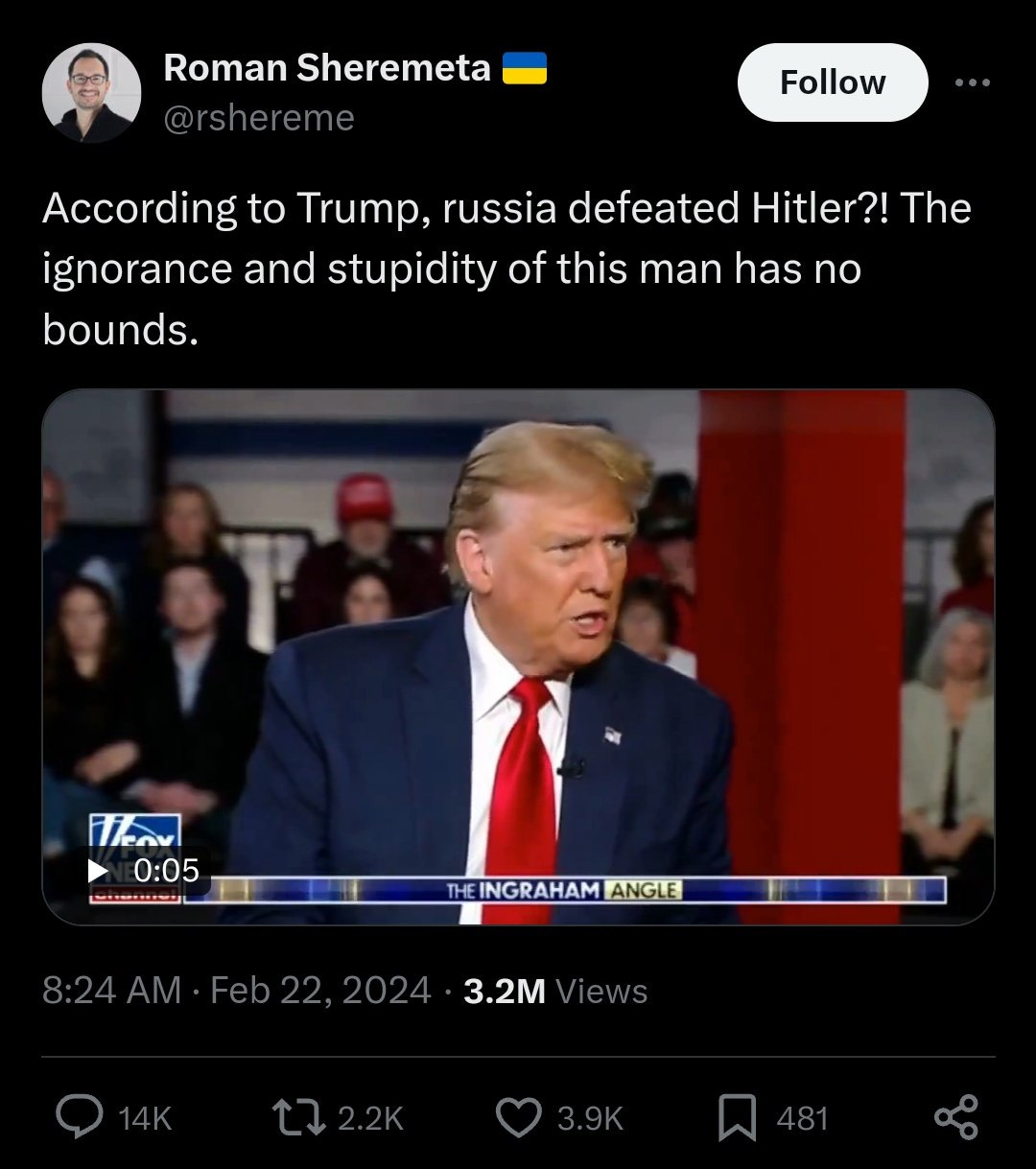
The guy who posted this has since deleted it because he was dragged massively by people who know actual history. In our current times of TDS and political hyperpartisanship, digs and “hot takes” against Trump seem to take precedence over reality.
Reality is important, however, so let’s briefly go over why this guy’s post is historically ignorant but also incredibly important to understand why it’s so ignorant if one wanted to actually understand the current geopolitical chessboard.
Let’s start with the overall casualties that the major Allies bore in WWII, and then we’ll get into the various fronts and one major battle that led to more loss of life than most (if not all):
Russian WWII casualties: estimated between 8 to 10 million
US WWII casualties: 416,800 killed, 670,000 wounded, 130,000 POWs
Total casualties for the Allies in WWII (these include Russian losses, as they fought for the Allies):
10 to 15 million deaths (with 8-10mm of those being Russian)
20 to 25 million wounded
Breaking out just a single element of WWII, let’s take a look at the Russian losses at the Siege of Leningrad, which was one of the longest and bloodiest sieges in all of history, lasting from September 1941 to January 1944 as German (Nazi), Finnish, and Spanish volunteer (Division Azul) forces attempted to take Russian territory:
1.2 to 1.5 million deaths of both military and civilian personnel
From WWII to the Cold War to Ukraine
Quite a bit has happened to relations between the US and West with Russia between the end of WWII and now. We quickly went from allies to frenemies to enemies, saw the rise and fall of the Berlin Wall, the Cuban missile crisis, multiple spies arrested and traded by each other, and many other things that we’ll get into a bit below.
While I could write this all out, the 20-odd minute clip below from RFK Jr and Lex Friedman outlines it far more succinctly and completely than I ever could.
Before I leave you to watch the clip - which I highly suggest that you do - it’s important that I take a moment to express the importance of having the ability to separate the message from the messenger sometimes.
The world and our nation in particular have been thrust into hyperpoliticization and propaganda on all fronts. This often leads to certain “sides” putting all of their efforts into discrediting (and often defaming) anyone who has a view, voice, platform, or message that runs contrary to their interests or overall narrative creation.
“When you can’t kill the message, you kill the messenger” is a common Bolshevik tactic, and we’re seeing it on full display right now.
We saw it when Joe Rogan started having guests on his show who questioned vaccines, and we’re seeing it with anyone who questions the narratives about the Ukraine war or Russia in general. Most notably we saw this very recently when Tucker Carlson interviewed Putin.
No matter how you feel about RFK Jr, the man has been one of a very small number who’ve been willing to push back against the propaganda on both fronts (vaccines and Ukraine), and he’s also more knowledgeable than most on both subjects given his lifelong proximity to both (vaccines as a lawyer and statecraft/foreign policy as the scion of a political dynasty).
I’ve read and watched a lot of content regarding the background of Russia and the Ukraine war. In everything from intelligence officer reports to mainstream media and the accounts of soldiers & mercenaries who’ve spent time on the frontlines (from 2014 to current as the war really started a decade ago), and the clip below is the best summary of what led to US/Russo tensions from post-WWII to now and why the Ukraine War began.
The clip below also explains in very simple terms why NATO still exists.
It was formed to act as a defense against Russia, but when Russia itself asked to join NATO (and was rebuked) and when pre-Nordstream destruction it was supplying energy and other resources to most of Europe, that organization became largely worthless for its stated intent.
So why does it still exist? Why is the US the only nation that pays its full NATO dues when the nations closest to “the threat” of Russia don’t bother to? It’s explained in the clip below.
Please take the time to watch, learn, and absorb. The best way to become impervious to future propaganda is to educate yourself on reality and begin to spot the narrative formation as it happens:
Economics
NATO Nations vs Russian GDP
For the rational observers among us, we’ve only seen 1 US leader in the past several decades who had a comprehensive policy that increased US strength, smoothed relations with Russia, and used economics rather than military means to keep Russia in check.
To fully appreciate why that was so effective, however, we have to lay out some black-and-white numbers that most Westerners probably don’t understand or know.
While the Russian threat is largely played up by the media and the China threat has been ignored (as we’ve funded their rise), the hard economics paint a clear picture of why Russia should never have been the threat that it was pretended to be since 2016.
In the end, it was all a paper tiger (or paper bear is perhaps more appropriate) and a boogeyman to take our eyes off of the true threat.
Russian vs lead NATO nations’ GDP
Russia: $1.5 trillion
USA: $22 trillion
UK: £2.3 trillion (roughly $2.92 trillion)
Germany: €4.3 trillion (roughly $4.65 trillion)
France: €2.8 trillion (roughly $3.03 trillion)
Take a moment to truly understand and internalize the numbers above. Not only is our GDP in the US over 10x that of Russia, but each of the lead NATO nations that are ostensibly aligned together against Russia (although most of them have some form of economic deals with the supposed enemy) have larger GDPs as well.
And again, despite their actually being on the European continent and our nation being an entire ocean away, we’re the ones funding the vast majority of NATO, despite the least amount of proximity threat from Russia.
If one were to contemplate RFK Jr’s statements above that NATO nations have to sign contracts to buy weapons from US defense contractors, however, a cynical person could begin to view it as yet another giant money laundering machine that is constantly seeking excuses for its existence outside of said money laundering.
Trump and Russia
However you feel about Trump, please refer to the message vs messenger note above as we move into this section.
Statecraft is often a function of leverage, in which politics and diplomacy become the lens through which leverage is used to gain strategic or economic advantages for one’s nation.
When the politicians and diplomats become hopelessly corrupted by money, power, blackmail, or zealotry, however, things go off the rails. When weak-spined or unintelligent people are put in charge due to nepotism or cronyism, it can get about as bad as it can get.
Again, we refer to von Clausewitz:
“War is politics through other means.”
For me, I don’t see Trump politically as a person as much as I see him as an archetype.
Perhaps that’s the author and creative within me, but the polling data that shows him increasing in popularity with every new political charge or attack that is levied against him seems to add a lot of credence to my thought process.
That is neither here nor there, and perhaps we’ll dive deeper into that thought process in a future post.
For now, let’s focus on why Trump was so effective at diplomacy with/containment of Russia, and what happened to destroy all of that progress that our nation had made.
First, Trump’s decision to make the US the world’s top energy exporter was not only a move that helped to drive US GDP and give American workers jobs. While it certainly did that, there was another geopolitical advantage that it created.
When Americans think of oil production abroad, they typically think of the Middle East and Saudi Arabia in particular.
We went through some other sources of oil in the Middle East and how it’s used to fund terrorism abroad in the previous Iran post, but let’s briefly cover what makes up Russia’s GDP to highlight why it is so important with respect to Trump’s policies:
Natural Resources:
Russia is known for its abundant natural resources, which play a significant role in its economy. Key sectors include:
Energy: Oil, natural gas, and coal extraction and production.
Mining: Metals and minerals such as iron ore, nickel, aluminum, and precious metals like gold and platinum.
Timber: Logging and wood processing industries.
Manufacturing:
Russia has a diverse manufacturing sector, producing a wide range of goods, including:
Machinery and equipment: Production of machinery, vehicles, aerospace equipment, and military hardware.
Chemicals: Petrochemicals, fertilizers, pharmaceuticals, and other chemical products.
Consumer goods: Production of textiles, food and beverages, electronics, and appliances.
Services:
The services sector is a significant contributor to Russia's GDP and includes various industries such as:
Financial services: Banking, insurance, and other financial activities.
Retail and wholesale trade: Sale and distribution of goods.
Transportation and logistics: Shipping, railways, air travel, and freight services.
Tourism: Hospitality, travel agencies, and related services.
Agriculture:
Agriculture plays a role in Russia's economy, although its contribution to GDP is smaller compared to other sectors. Key agricultural products include grains (wheat, barley), vegetables, fruits, dairy, and livestock.
Technology and Innovation:
Russia has a growing technology and innovation sector, with investments in areas such as:
Information technology: Software development, IT services, and telecommunications.
Research and development: Science, technology, and innovation initiatives aimed at fostering technological advancement and competitiveness.
Government Spending:
Government expenditure, including investment in infrastructure, defense, education, and healthcare, contributes to GDP.
Exports and Imports:
International trade, including exports of goods and services (such as energy products, metals, and machinery) and imports (including consumer goods, machinery, and technology), affects Russia's GDP through net exports.
Of all of the aspects of Russian GDP that are listed above, oil and energy are the “bread & butter” of their economy. Another crucial aspect of the global economy that many don’t realize is that Russia is also one of the top 3 producers of potash globally, which is a vital requirement for commercial farming.
There were a lot of commodities traders who began to raise the alarm about this when Biden announced sanctions against Russia, who were also worried because Ukraine is another of the world’s top potash producers.
Trump’s increases in US energy production not only damaged Russian GDP by lowering the cost of energy globally (simple supply vs demand), but it also offered the opportunity for Western Europe to facilitate their energy needs by buying from the US instead of Russia.
He warned them that depending on Russia for oil & gas would not only be a dangerous gambit that left them dependent upon Russia but that it also rendered the very stated purpose of NATO obsolete.
The NATO leaders laughed at him, and now as a result of their hubris the domestic manufacturing production in Germany and the cost of heating across Western Europe have become significant issues.
Having an understanding of leverage through business rather than politics, Trump knew this put the US in an advantageous position, reducing Russia’s ability to fund any kind of major military action, and would give us the upper hand in any negotiations, should they be needed.
If you read the previous Shitshow Macro Issue 2.5: A decade of (orchestrated?) chaos, Hidden History post, you know that Obama’s incursion into Syria began just a couple of years before Trump took office.
What you may not know (because the media quickly buried it) is that Trump ordered one of the only direct, kinetic actions between US and Russian forces that have taken place since the end of WWI in what would become known as The Battle of Kasham.
Syria quickly became a convoluted war of proxies, with the US aligning with Kurds and pro-Syrian forces to fight ISIS, and Russia aligning with Syria and Asad to fight ISIS but also to protect the nation’s oilfields.
Proxy wars are often guided by and through Special Operations or Private Military Contractors (PMCs), and we aren’t the only nation to have a version of Green Berets, nor was Blackwater the first PMC to support a nation-state.
Within that context, a Joint Terrorism Task Force (JTTF) of about 40 people from Joint Special Operations Command (JSOC) made up of Rangers, Delta, and Air Force Combat Controllers (CCTs) were stationed at a Conoco oil field in Eastern Syria. An ODA of Green Berets was just 20 minutes away at their own Combat Outpost (COP), which had been focused on a different mission within the greater national strategy.
In early 2018 the JTTF noted a massive group forming near their position. The drone and other feeds showed the enemy force amassing nearly 500 fighters with tanks and artillery, so they called the ODA to prepare to launch a Quick Reaction Force (QRF).
Because neither nation-state (Russia and the US) wanted the proxy war to escalate into a full-blown war, they had established a “hotline” between the two nations for deconfliction when needed. General Mattis called his Russian counterpart, who denied that it was Russian forces aligning against the US JTTF.
After hanging up the phone, the order was given for the JTTF “to annihilate the enemy forces,” and they did so with the type of totality that US SOF is known for. All told between 200-300 mercenaries from the Russian Wagner group and their Syrian fighters were killed before the rest could escape, along with an enormous blow to their armor and artillery.
If you want to know more about it, you can read it here:
The Russian Collusion Hoax that impeded peace and economic potential
Those of us who knew about both aspects of what was covered above - Trump’s moves putting us in an advantageous economic position and a military position of strength - knew the Russian Collusion Hoax and media caterwauling about Trump being “Putin’s puppet” was about as garbage as a narrative could ever be.
And yet, they pushed on with it and were allowed to tear the nation apart for years. There are still people who believe it, even after Mueller was revealed to be a political witch hunt and the Wikileaks Podesta emails showed his plan to tie Trump to Russia to take heat off of Hillary’s poor polling as being “too weak on Russia.”
While the short-term political move was to impede Trump’s presidency, the blowback from the Hillary Clinton campaign, FBI, CIA, and Western corporate media’s lies have been incredibly damaging. Not only did it effectively tear the country apart and turn friends, families, and neighbors against each other, but it purposely removed all leverage and political advantages that Trump had set up for the US against Russia.
We were finally in an extremely advantageous position in that relationship that could be utilized in purely economic terms with no need for further war.
Putin would not have had the money for a major military action in Ukraine had the US remained the top global energy exporter (keeping prices down). And we can only imagine what potential economic cooperations and agreements could have been made had Trump’s hands not been tied for most of his presidency with regard to any major negotiations or cooperative deals with Russia.
Biden’s Counterproductive Sanctions
The knuckleheads in charge of foreign policy for the Biden Regime made the mistake of thinking that they still had leverage against Russia in both military and economic terms, and they’ve been proven astoundingly wrong on both fronts.
Have you ever taken a moment to wonder why US sanctions against Russia only made The Bear richer? And how it was that the BRICS coalition, with 40 countries now either having joined or considering joining to ditch the US dollar, all happened so quickly after Biden announced his “sanctions that would cripple the Russian economy?”
Have you paid attention to any of what we’ve already covered above?
If you haven’t, here are the broad strokes:
Russia has pretty good reason not to trust the US, especially when Neocons are in charge
Russia and Putin knew that the USD had become an offensive tool of economic war, and had already been creating their own version of the SWIFT system for financial transactions
When the US announced publicly that it was seizing Russian funds and assets, it sent a shockwave through other nations that the same thing could happen to them if they disagreed with US policy
As we outlined in the Iran post, US policy going full rainbow jihad under the Biden/Obama frame of thinking is a significant turn-off and a bridge too far for many nations around the world
Despite decades of foreign policy having been focused on keeping Russia, Germany, and China from becoming too friendly, Biden’s actions only brought China & Russia closer
With China’s keen focus on building economic power, the BRICS alliance suddenly had China’s assets and Russia’s SWIFT alternative as a major selling point, along with a massive amount of commodities
Commodities traders knew that Russia had been building up its reserves of gold and other precious commodities pre-Ukraine invasion. While it was not as easy to catch wind of, there were others who were publicly sounding the alarm about Russia’s SWIFT alternative that had been in the works pre-invasion as well.
Between the gold, SWIFT alternative, and alliance with China, Russia had successfully made itself Western sanctions proof.
When Biden’s anti-energy policies reduced supply and drove prices sky-high, Russia made a killing off of the increased oil & gas prices.
And the rest, they say, is history. Biden just announced another round of sanctions against Russia for Navalny’s death.
What is it that they say is the definition of insanity?
But I’m sure this time it will be different. (sarcasm)
How This Foreign Policy Fumble (blowback) Led to a Shitshow
If you’re still with me, let me briefly wrap all of this up to explain why it matters in our present moment.
If you watched the Tucker Carlson interview with Putin, you know that a large part of the time was spent with Putin delivering a history lesson. Many Westerners scoffed at that aspect of it, but perhaps now you understand why he did that.
As we covered in the previous Iran post, it’s vitally important to understand that other (older) cultures often see the world in a very different perspective than we do here in the US. Our nation is a little over 200 years old, and we’re dealing with nations that are sometimes thousands of years old, even if not as an official nation but still as a culture.
The timelines of wars, alliances, friends, and enemies from a Russian perspective show that things can shift in massive ways in terms of statecraft, but from my vantage point, it seems as if we’re walking directly into another World War if we don’t alter our current trajectory with regard to Russia and Ukraine.
Just as I tried to outline from the very beginning of these posts, the media is currently misinforming people to a great degree about what is going on in the world. One of the most dangerous parts of what they’re currently doing is leading Americans to believe that the Ukraine War and our actions are about Russia and only Russia.
This is categorically false, and while they do their best to paint them as different issues, the conflagrations that we currently see going on in the Middle East (Syria, Iraq, Yemen, Strait of Hormuz), the US border, and Ukraine are all related (in my opinion Taiwan is going to join that list soon).
An accurate and honest assessment of how we got here with regard to Russia could be chalked up to a very long series of tragically bad foreign policy decisions at best, or a massive boogeyman construction to hide an international money laundering scheme (NATO) at worst.
It would be nice to have some adults in the room who could end the decades-long blood feud that our foreign policy establishment has been waging with Russia, given that China is by far the greater threat in many respects.
Russia doesn’t have the capacity or capability to be the global hegemon even if it wants to.
China however does, and it only does because we gave it the economic capacity and a toolbox of dirty tricks that could be used to seize and wield global control.
And if you think that Russia has legitimate grievances against the West for what our foreign policy establishment has done to them over the decades, just wait until you hear about the reason that China developed the 100-year plan to totally overthrow and decimate the Western world as payback for past offenses.
That’s what we’ll be covering in the upcoming China post.
Until then stay alert, stay alive, and stay informed so that you can continue to rage against the dying of the light, my friends.
I’m terrible at asking others for things, but…
It’s my intention to keep this platform free to read, but with the ability for people to donate if they are so inclined and feel the content here is worth their hard-earned dollars. These posts take quite a bit of time and research, but as I work it into my routine the flash-to-bang on new posts should reduce dramatically.
If you are so inclined and feel this is worth your time to subscribe for updates, share with others, or become a paid member, I’d greatly appreciate it.
Regardless, we’re all in this shitshow together. I’m going to do what I can to help you see the bigger picture and keep your eyes on the things that matter.
Until next time,
RPL